
If you’ve been watching the news this month, you’ve seen the headlines.
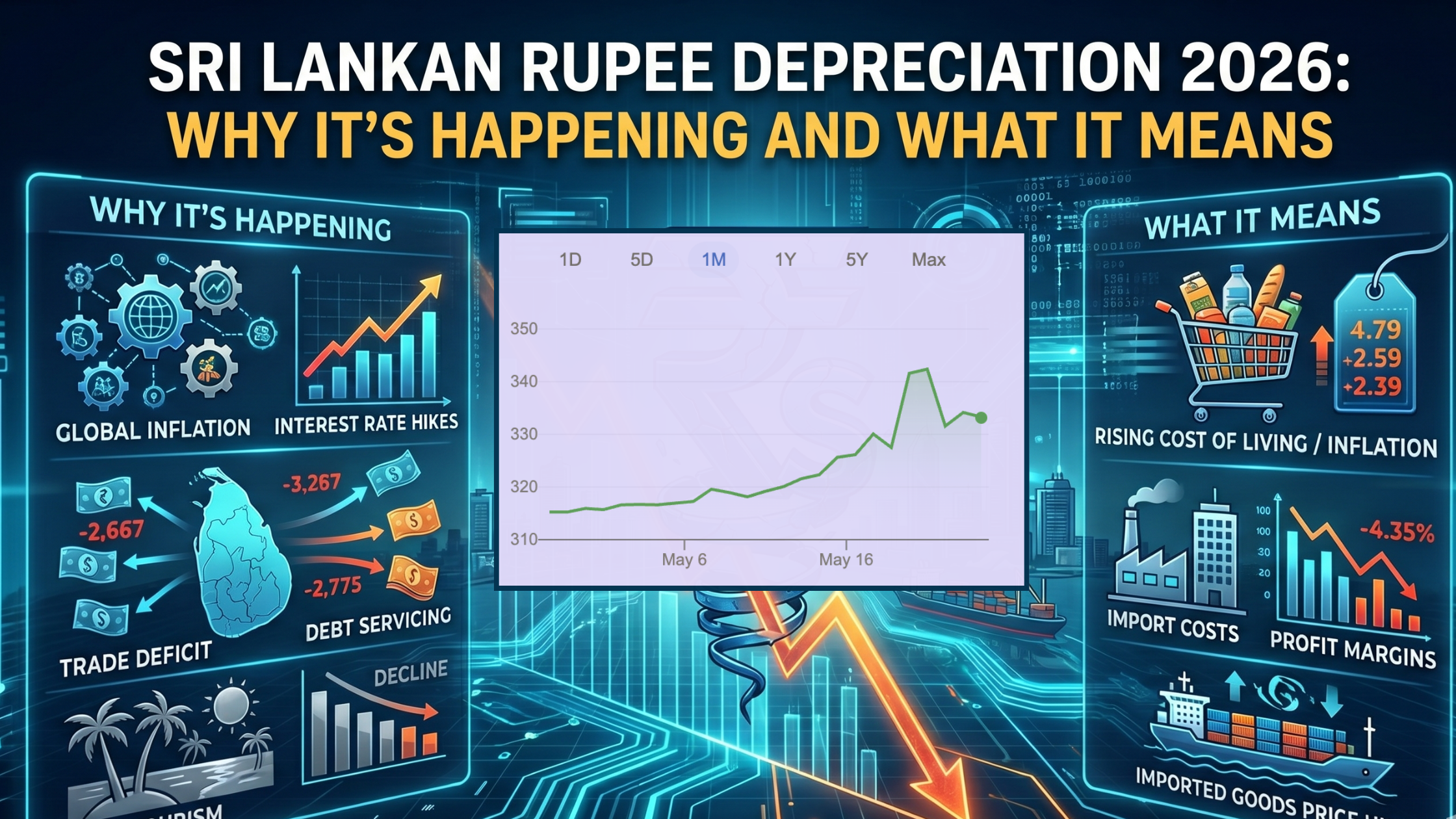
The Sri Lankan rupee went through one of its most volatile weeks since the 2022 crisis—briefly crossing Rs. 350 against the US dollar, then staging a dramatic recovery. By May 25, the dust had settled somewhat, but the currency has still weakened significantly from where it started the year.
As a digital marketing strategist based in Colombo who tracks economic data closely, I’ve been following every twist. This article breaks down what actually happened, why the Central Bank Governer says this is different from 2022, what caused the panic, how it was resolved, and what it all means for your business and daily life.

The Numbers: A Month of Turmoil
Let’s start with the hard data. The Sri Lankan rupee began 2026 at around Rs. 309 per US dollar. By early May, it had depreciated about 4.8%, which was manageable. Then things accelerated dramatically.
According to CBSL data, the year-to-date depreciation jumped from 4.5% on May 15 to 7.2% by May 22—the sharpest weekly deterioration of the year. The selling rate crossed Rs. 350 on May 21, hitting a three-year low. Major institutions like Bloomberg reported the rupee as Asia’s worst-performing currency in May.
Data from the Federal Reserve Bank of St. Louis (FRED) confirms the trend, and you can track daily rates on the CBSL exchange rate page.
But here is the crucial point that CBSL Governor Dr. Nandalal Weerasinghe has been emphasising: this is not 2022 all over again.
This Is Not 2022: Why the Governor Says It’s Different
Speaking at a media briefing on May 13 and later before the Parliamentary Committee on Public Finance (COPF), Dr. Weerasinghe made a crucial distinction. In March–April 2022, the rupee collapsed to Rs. 370 per dollar purely because of internal factors—depleted reserves, excessive money printing, fiscal mismanagement, and a complete loss of market confidence.
“That was a completely internal event. There was no external shock at that time. Other currencies did not depreciate that much. This was specific to the Sri Lankan currency,” the Governor said.
In contrast, the current depreciation is happening alongside similar declines in regional currencies. The Indian rupee, Thai baht, and Philippine peso have all weakened against a strengthening US dollar. Even India, with approximately $700 billion in foreign reserves, is seeing its currency at historic lows. The IMF Mission Chief for Sri Lanka, Evan Papageorgiou, also expressed confidence in Sri Lanka’s ability to manage the pressures, citing the country’s stronger policy framework and improved reserves.
The Three Main Reasons Behind the Depreciation
1. The Fuel Import Shock
The single biggest driver is the surge in global oil prices triggered by the Middle East conflict. Sri Lanka is a fuel-importing nation, and when oil prices spike, our import bill skyrockets.
President Anura Kumara Dissanayake revealed the staggering numbers in a public address: fuel imports surged from $98 million in February to $216 million in March, $368 million in April, and a massive $522 million in May. That is more than a five-fold increase in just four months. Deputy Finance Minister Dr. Anil Jayantha confirmed that the country’s monthly fuel import bill rose from the usual $120–200 million range to $521 million.
This massive surge in dollar demand for essential imports created a severe imbalance in the foreign exchange market, and under Sri Lanka’s flexible exchange rate regime, the rupee adjusted accordingly.
2. Slowing Tourism Revenue
Tourism has been one of Sri Lanka’s strongest forex earners post-2022. But President AKD confirmed that tourist arrivals dropped 29% in April 2026 compared to the same period last year—a direct consequence of the Middle East crisis. I previously wrote about how Sri Lanka can capture the Middle East luxury tourist market, and that opportunity still exists. But in the short term, fewer tourists mean fewer dollars coming in.
3. Speculation and Market Psychology
This factor is new and critical to understanding last week’s panic. Deputy Finance Minister Anil Jayantha Fernando told Parliament that the slide intensified due to speculation—importers rushed to buy dollars while exporters delayed converting their foreign earnings, creating a self-reinforcing cycle.
Foreign investors also sold over US$14.7 million worth of Sri Lankan government securities in the week ending May 14, adding to the pressure. Meanwhile, worker remittances remained steady, but exports haven’t grown enough to counterbalance the surge in imports.

What Happened During the Panic Week (May 18–22)
The week of May 18 was extraordinary by any measure. Here is a day-by-day breakdown:
- Monday (May 18): TT rate stood at Rs. 326.74 buying, Rs. 334.27 selling. Pressure was building but manageable.
- Wednesday (May 20): The rupee crossed Rs. 340. CBSL met with bankers and currency dealers to discuss tighter regulations.
- Thursday (May 21): Panic peaked. The TT rate hit Rs. 342.63 buying and Rs. 354.03 selling. The rupee was Asia’s worst-performing currency.
- Friday (May 22): Dramatic reversal. Bloomberg reported the rupee strengthened 2.7%—becoming Asia’s best-performing currency that day. CBSL stepped in with an informal cap around Rs. 330 for interbank trading. The spot market eased to Rs. 329/Rs. 335.
- Weekend (May 24–25): Minister Bimal Ratnayake and Deputy Finance Minister confirmed rates had stabilised around Rs. 330–334, with USD 700 million in IMF funds expected to be approved on May 27.
It’s Not Just Sri Lanka: The Regional Picture
One of the most important points is that this is a regional phenomenon, not a uniquely Sri Lankan crisis. The Governor noted:
“Relative depreciation of our currency to regional currencies is on a compatible basis. Whereas in 2022, we depreciated by 45% while others appreciated.”
- The Indian rupee hit its lowest level in history in May 2026.
- The Thai baht and Philippine peso both weakened significantly against the dollar.
- The US dollar itself has strengthened globally as investors seek safe-haven assets.
In 2022, Sri Lanka was the outlier. In 2026, we’re moving in the same direction as our peers, responding to the same global shock.
What This Means for Businesses and Everyday Sri Lankans
A weaker rupee has real consequences:
- Imported inflation: CCPI inflation jumped from 2.2% in March to 5.4% in April and is expected to rise further. The Consumer Lanka Association warned prices of imported items could increase by 25%.
- Fuel and energy costs: With fuel imports at $522 million in May alone, electricity tariffs and transport costs face severe upward pressure.
- Poverty impact: Economists warn that with 24% of households already below the poverty line, sustained depreciation could push more families into hardship.
However, there is a silver lining. A weaker rupee improves export competitiveness. The flexible exchange rate acts as a natural shock absorber. And with IMF Board approval expected on May 27 for the 5th and 6th reviews (unlocking ~USD 700 million), plus additional funds from ADB and World Bank, Sri Lanka’s forex position is expected to strengthen in the coming weeks.
The Bottom Line
The Sri Lankan rupee’s depreciation in 2026 has been real and at times alarming. But it is fundamentally different from the 2022 crisis. The pressure is coming from external shocks—the Middle East conflict driving oil prices, global USD strength, and market speculation—not domestic mismanagement.
The CBSL’s foreign reserves, while slightly down, remain in the $6.5–7 billion range. The economy is on a stronger footing with IMF backing. And the flexible exchange rate regime is doing what it’s designed to do.
That doesn’t mean the pain isn’t real. Import costs will rise, inflation will be a concern, and vulnerable households will feel the pinch. But panicking doesn’t help. Understanding the real drivers—and recognizing this is a shared regional challenge—is the first step toward informed decisions.
Frequently Asked Questions
Is the Sri Lankan rupee crisis as bad as 2022?
No. In 2022, the rupee depreciated 45% due to domestic mismanagement and default. In 2026, the depreciation is driven by external factors. The economy has improved reserves ($6.5–7B), IMF support, and a stronger policy framework. However, the speed of last week’s panic shows the market remains sensitive.
What did the Central Bank do to stop the panic?
The CBSL met with bankers and currency dealers, provided dollar liquidity to the market, and informally capped the interbank rate around Rs. 330. They are also considering shortening the mandatory conversion period for export proceeds from 90 to 30 days to increase dollar supply.
When will the rupee stabilise?
The IMF Board is expected to approve the 5th and 6th reviews on May 27, unlocking ~USD 700 million. Combined with expected ADB and World Bank funds, this should strengthen forex reserves. However, the trajectory depends on global oil prices and the resolution of the Middle East conflict.
How does this affect my daily life?
A weaker rupee means imported goods become more expensive—fuel, electricity, food, medicine, and transport costs all face upward pressure. If you earn in rupees but use imported products or inputs, you will feel the impact.