Building a personal brand feels like a second, unpaid job. If you’re a founder, a high-growth CMO, or an ambitious strategic marketer, you don’t have three hours a day to spend manually scheduling LinkedIn posts, editing video clips, and searching for ideas.
I spent years trying to handle all my content manually. It resulted in inconsistent output, low visibility, and total burnout. That manual hustle is completely unsustainable if you want to scale a profitable brand. By 2026, the game is no longer about who can publish the most; it’s about who can maintain authenticity and authority at scale.
Here is the truth that most SEO gurus won’t tell you:
- The rise of generative AI means the market is saturated with machine-generated noise.
- Google’s E-E-A-T standards demand that content must prove specific, verifiable experience.
This means your personal brand automation has to act as an amplifier for your expertise, not a cheap replacement for your brain. Stop chasing algorithms and start chasing user problems.
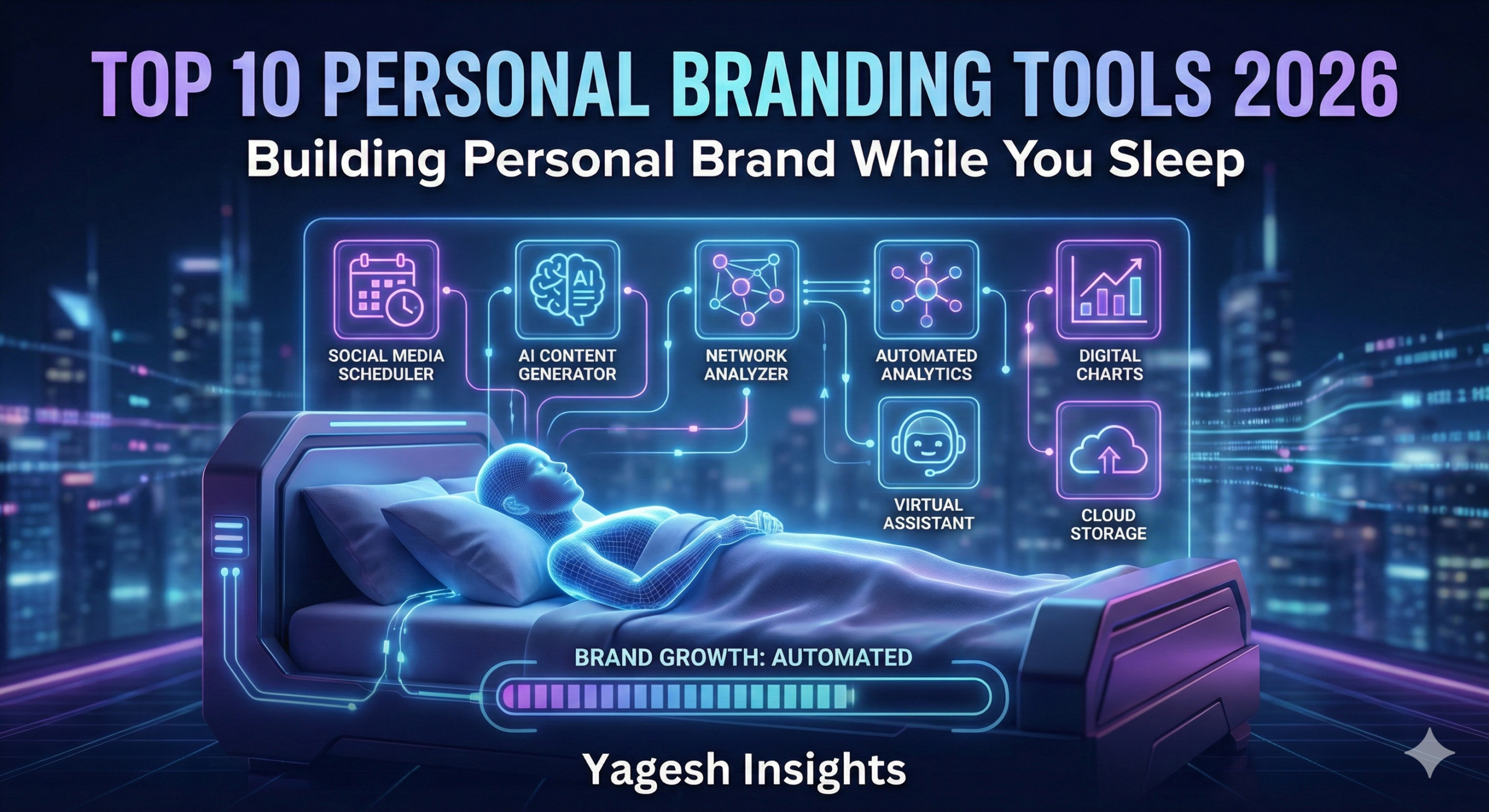
Here is my playbook. This is how I structure my growth systems now, using tools that let me focus on high-value strategy while the repetitive work gets done while I’m sleeping.
The 2026 Personal Branding Mandate: Authenticity at Scale
In my five years of auditing high-growth startup websites, I consistently see founders producing what I call “SEO wallpaper.” It’s technically correct content, but it lacks the unique stamp of experience. A successful personal brand in 2026 is one where the automated processes enhance the visibility of your unique perspective.
The only thing separating you from the noise is your verifiable Experience and Expertise. If you automate away the parts that make your voice unique, you have failed the E-E-A-T test before you even hit publish. This is the crucial distinction:
- We use AI for efficiency.
- We prioritize the human element for impact.
This raises immediate ethical questions regarding how we use automation to manage professional reputation. You must establish clear boundaries about what is written by you and what is assisted. The Ethics of AI in Professional Reputation Management (Harvard Business Review) is required reading for anyone serious about this. **Your long-term trust is more valuable than any short-term viral hit.**
The 10 Tools I Use to Keep My Brand Running (Even When I’m Sleeping)
Category 1: Idea Generation & Content Assembly
1. The Expert Interview AI Assistant (Custom Workflow)
Forget generic ChatGPT prompts. The future of content creation is highly customized, domain-specific AI models, often built on private data sets. I use a custom workflow that allows me to “interview” myself. I speak my strategic thoughts into a recorder for 20 minutes, discussing a client project or a specific system I built. The AI then processes that raw transcript, identifying key insights, and structuring them into useful formats.
The system automatically generates:
- A long-form blog outline.
- Five LinkedIn hooks.
- Three Twitter threads.
Key Takeaway: The output is still raw and needs heavy human refinement, but it reduces the writing time from four hours to 45 minutes.
2. Descript (For Repurposing Video)
Video is mandatory. But editing video to pull out short, punchy clips for TikTok, Shorts, or Reels is a massive time sink. Descript lets me edit video by editing text. I use it to:
- Clean up transcripts and remove filler words.
- Instantly cut clips based on what I said.
- Auto-generate subtitles and optimize aspect ratios.
By 2026, Descript’s ability to fix the occasional “um” makes it non-negotiable for video-led expertise.
3. The Semantic Content Optimizer (Surfer/Clearscope Pro)
I don’t care how brilliant your insights are; if Google doesn’t understand the topic cluster, you lose. I run every critical piece of content through an SEO content optimizer before publishing. These tools ensure that the final draft hits the necessary semantic density, meaning you cover the user’s intent completely.
I recently implemented this structure for a client in Colombo, and **their topic cluster performance jumped 30% in three months.** That’s the power of verifiable topic completeness.
Category 2: Distribution, Scheduling, & SEO Verification
4. Hypefury/Postwise (For Social Thread Automation)
LinkedIn and X (Twitter) are essential for rapid personal brand growth, but scheduling dozens of individual posts is tedious. Tools like Hypefury allow you to build vast libraries of evergreen content and schedule automated retweets or follow-up posts weeks in advance. Crucially, they facilitate the automated building of structured threads, which helps distribute complex ideas effectively while you are focusing on high-level strategy.
Yagesh’s Rule: Use these tools to distribute *your* pre-written ideas, not to generate filler text. If you let the bot write the ideas, your authenticity suffers.
5. Ghost or ConvertKit (Focused Newsletter Automation)
Social media is rented land. Your email list is your owned channel. I use systems like Ghost or ConvertKit because:
- They integrate deeply with my website infrastructure.
- They allow me to run A/B tests on subject lines automatically.
- The automation focuses on segmenting audiences based on their declared interest.
This segmentation ensures I deliver the right case study to the right founder at the right time.
6. Zapier or Make.com (The Integration Backbone)
None of this scaling works if the tools don’t talk to each other. Zapier or Make.com are the central nervous systems of my digital operations. This is foundational system building; it’s what turns manual effort into a predictable machine:
- When a blog post publishes, Zapier automatically pushes the optimized title and featured image to my social scheduler.
- When a new lead signs up for my newsletter, Zapier adds them to my CRM.
7. Ahrefs/SEMRush Brand Monitoring
Part of personal branding is understanding where your name and content are appearing in search and across the web. I set up alerts in Ahrefs and SEMRush specifically for my name, my unique system names, and my key strategic topics.
This helps me:
- Track unlinked mentions for potential outreach.
- Ensure I am aware of new competitors or discussions immediately.
This is proactive digital reputation management.
Category 3: Reputation & Authority Monitoring
8. Talkwalker Alerts (Real-Time Sentiment Analysis)
For high-profile founders, knowing the sentiment around your name in real time is critical. Talkwalker moves beyond simple keyword alerts; it uses sophisticated machine learning to determine the emotional tone of mentions across social media, news, and blogs.
This allows us to rapidly address negative feedback or amplify positive reviews, solidifying trust in the market. Digital Authenticity and Trust in the Age of Social Automation (Pew Research) shows that consumer trust is now the scarcest resource-you must monitor it closely.
9. Testimonial.to (Automated Social Proof Collection)
E-E-A-T isn’t just about what you say about yourself; **it’s what others say about you.** Testimonial.to simplifies the process of requesting, collecting, and displaying video and text testimonials. Crucially, it provides widgets that update automatically on your site and easy share links for social proof campaigns.
Stop manually tracking down former clients for quotes. Build a system that collects proof while you close the next deal.
10. Dedicated AI Ethicist Tool (The Policy Enforcer)
This is less a single tool and more a custom integration required for 2026. As my team and I scale content creation, we built a final check system. This system reviews content generated or assisted by AI for consistency against our brand guidelines.
The Ethicist Tool ensures:
- Tone compliance is maintained.
- No facts were hallucinated.
It is a mandatory compliance layer that ensures that even if I produce 100 pieces of content a month, every single one sounds authentically like Yagesh.
Stop Chasing Algorithms, Start Chasing User Problems
My five years of auditing high-growth startup websites has taught me one recurring disaster: focusing too much on the algorithm’s mechanics rather than the user’s needs. Tools are just accelerators. They don’t generate the insights; you do.
If you implement these systems, you will find yourself spending less time scheduling and more time solving hard problems-which is what your audience pays you for. **The goal of 2026 personal brand automation is to increase your time for genuine expertise creation.** The less time I spend on mundane distribution, the more time I have to refine my strategies and deliver unique, profitable insights for my clients.
Frequently Asked Questions
Is it safe to automate my personal brand with AI?
Yes, but only if you retain editorial control. Automation should handle the scheduling, repurposing, and initial drafting. Your role is the final editor and strategic architect. I recommend a **70/30 split**: 70% of the content is informed by your direct experience and 30% of the assembly is handled by the machine.
How do I ensure my automated content still feels authentic?
Authenticity is preserved by feeding the AI assistant unique source material, such as meeting notes, proprietary client outcomes, or raw video thoughts. If you feed the machine generic data, you get generic output. Feed it your specific, verifiable expertise, and it will reflect your voice.
What is the single most important tool on this list?
The Integration Backbone (Zapier/Make.com). If your systems aren’t connected, you’re not scalable. Automation fails when the flow of information is bottlenecked. The ability to automatically sync data and trigger processes is the **foundational layer** for building a brand while you sleep.