I’m Yagesh Shanmuganathan, and I have a stark reality for you: If you are building a personal brand without a rigorous, financially defensible attribution model, you are not investing—you are speculating. And frankly, speculation is for hobbyists, not serious small business owners.
For too long, the concept of Personal Brand ROI has been shrouded in fluffy metrics and motivational jargon. We have worshipped at the altar of vanity follower counts, high engagement rates, and the fleeting endorphin rush of a viral post. But does that virality pay the rent? Nine times out of ten, it doesn’t.
As we barrel toward 2026, the digital landscape is hardening. AI is aggregating content faster than we can create it, organic reach is plummeting, and audience trust is at an all-time low. Your personal authority is no longer a soft asset; it is a critical infrastructure component that must be measured with the same precision you apply to inventory management or payroll. This post is my mandate to you: Stop guessing. Start calculating. I am introducing the Authority Attribution Model (AAM), a three-phase framework designed specifically for small business owners who need concrete, measurable returns on their time investment, focusing entirely on hard metrics and quantifiable leverage.
The Illusion of Reach: Why Your Follower Count is a Lie
If you walked into a bank and asked for a loan based on your high ‘Like’ count, you’d be laughed out of the building. Yet, many entrepreneurs treat their personal brand strategy as if high reach is synonymous with high revenue. It isn’t.
Standard articles on measuring personal brand success fail to differentiate between *noise* and *signal*. A 100,000-follower audience comprised primarily of competitors, bots, or people outside your target demographic is financially worthless. In contrast, 500 deeply engaged, relevant leads who trust your expertise implicitly is an asset of extraordinary value. The former is speculation; the latter is leverage.
My core strategy removes the subjective fluff and focuses on three actionable financial outcomes of building your authority:
- Increased Credibility Quantification (CQ): How quickly does your brand eliminate skepticism?
- Monetized Authority (MA): Direct revenue generated or costs saved by brand leverage.
- Efficiency Dividend (ED): The measurable reduction in your Customer Acquisition Cost (CAC).
This is the true measure of Personal Brand ROI. Let’s break down how we quantify each.
Phase 1: Quantifying Credibility (The CQ Score)
Credibility is abstract, but its effects are not. The fundamental goal of a personal brand is to collapse the discovery and trust phases of the buyer journey. When you have high credibility, fewer objections are raised, and sales cycles shorten dramatically. This is the essence of credibility quantification.
We need proxy metrics that directly reflect the trust level of inbound interactions. Forget ‘saves’ and ‘shares.’ Look at:
Formula Focus: Moving Beyond Engagement Rate
The standard engagement rate (ER) is flawed because it treats a low-value “fire emoji” comment the same as a high-value specific question about pricing or implementation. We must shift to measuring the Lead Quality Index (LQI).
To calculate your LQI:
- Identify High-Value Interactions (HVIs): These are interactions that explicitly reference your specific methodologies, request a consultation, or refer a peer (e.g., “Loved your post on the Hard Metrics Framework, can we discuss Q4 implementation?”).
- Track HVI Conversion Rate: Divide the number of HVIs that convert into qualified meetings by the total number of content views needed to generate those HVIs.
A small business owner using this framework might find their LQI is high even if their overall ER is low. This tells us the content is working as a targeted lead magnet, validating the investment. Your CQ score increases when:
- The average length of time between first contact and closing a deal decreases by 20%.
- The rate of “cold” inbound contact requests citing a specific piece of your original thought leadership increases by 30%.
- You are invited to speak or be quoted by Tier 1 industry publications (an external validation of brand equity calculation).
Phase 2: Calculating Monetized Authority (MA)
This phase is about direct revenue attribution. When we talk about monetizing authority, we are measuring how your reputation acts as a surcharge—an invisible, justified premium layered onto your services or products.
The most powerful component of MA is what I call the Leverage Multiplier. This metric is crucial for consultants, coaches, and service providers.
The Leverage Multiplier
Consider your average market rate (MR) for a specific service versus the rate you command (CR). The difference is your brand value.
$$Leverage Multiplier = frac{CR – MR}{MR}$$
If the standard market rate for a strategic SEO session is $500, but because you are Yagesh Shanmuganathan (hypothetically), clients happily pay $1,500 for the same hour, your Leverage Multiplier is 2.0. This 200% premium is the direct, quantifiable ROI of your personal brand equity. Every time you increase your prices without a corresponding increase in pushback, you are monetizing your authority.
For product-focused small businesses, MA is calculated by:
- The Referral Revenue Stream: Tracking sales generated *explicitly* through personal recommendations stemming from your authority (e.g., clients saying, “I bought this because Jane recommended it on her webinar”).
- Premium Product Adoption: Tracking the percentage of your audience willing to pay for your highest-tier product, often driven by trust in the founder’s promise, rather than just feature comparisons.
If you cannot link a percentage of your revenue directly to the fact that *you* are the person delivering the service or endorsing the product, your brand is operating as a cost center, not a profit center.
Phase 3: The Efficiency Dividend (Reducing CAC)
The most underrated metric when calculating Personal Brand ROI is the hidden efficiency dividend. A powerful brand acts as a gravitational pull, reducing the need for costly outbound marketing, cold outreach, and paid advertising.
For a small business, reducing your Customer Acquisition Cost (CAC) is often more financially impactful than increasing gross sales, especially in the early growth phases. When a prospect knows, likes, and trusts you before the sales call even begins, you bypass expensive nurturing sequences.
Where does this dividend come from? Referrals. A strong personal brand fuels an organic referral engine, and those customers cost you virtually nothing to acquire beyond the cost of delighting the referrer.
Case Study Proxy: The Referral Pipeline Value (RPV)
To quantify the RPV, you must meticulously track how many qualified leads enter your pipeline without touching paid ads, cold email sequences, or traditional SEO efforts that require heavy resource investment (i.e., leads citing your LinkedIn posts, newsletter, or a direct peer recommendation).
$$CAC Reduction = (Total Cost of Organic Leads) – (Total Cost of Paid Leads)$$
The stark reality is that the higher your personal authority, the closer your organic CAC moves toward zero. In 2026, when major platforms require increasing ad spend to maintain visibility, your established authority is a robust, deflationary hedge against rising marketing costs. This is tangible brand equity calculation.
Implementing Your Personal Brand ROI Dashboard for 2026
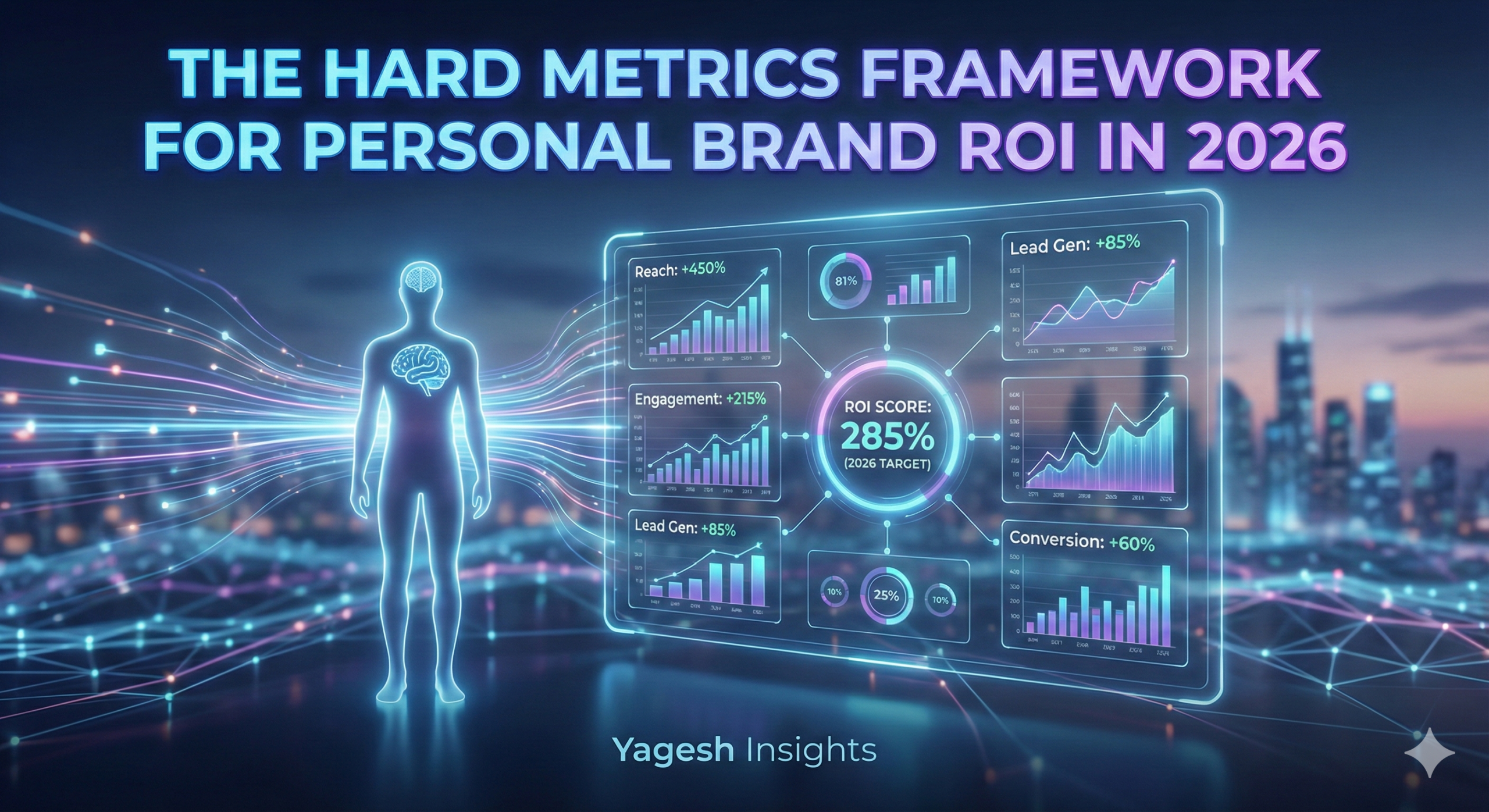
To apply this framework, small business owners need to structure their reporting around these three hard metrics:
- The CQ Tracker: Focus on the length of your sales cycle and the percentage of inbound inquiries that become Qualified Meetings (QMs) vs. Unqualified Leads (UQLs).
- The MA Tracker: Monitor your Leverage Multiplier. Review pricing every six months. If your brand is growing stronger, your prices should be rising independent of inflation.
- The ED Tracker: Isolate your referral revenue and organic social/content revenue streams. Compare the cost (time/money) of generating $1,000 via paid ads vs. generating $1,000 via your personal content.
These metrics are not “nice-to-haves”; they are the foundational proof points that your personal brand is a genuine, revenue-driving asset, not merely a time sink.
Final Thoughts: Stop Investing in Air
I cannot stress this enough: The era of soft marketing is dead. In the complex ecosystem of 2026, only brands built on authenticity, utility, and relentless measurement will survive. If you cannot provide a CFO-level explanation of how your personal content strategy directly shortens the sales cycle, increases pricing power, or reduces your marketing overhead, then you are simply investing in air.
Building authority takes consistent effort, but when you implement this hard metrics framework, you transform your time from a sunk cost into a highly visible, high-yield asset. Start measuring personal brand success the way the market measures value: in cold, hard cash and measurable efficiency gains. That is the only Personal Brand ROI that truly matters.